


Lighting a Georgian Home
The best Georgian light fittings follow the rules the houses were built on: proportion, symmetry and restraint. In practice that means one central fitting in the principal rooms only, wall lights in matched pairs at 1.5 to 1.8 m from the floor, lamps for the rest, and a warm white of about 2,700 K. Many Georgian houses are listed, so check before you add a new light point or touch historic plaster.
How Georgian rooms were lit
The Georgian Group dates the period from 1714, when George I came to the throne, to 1830, when George IV died. Its architecture drew on Palladio, who sought to revive the principles of ancient building: proportion, symmetry and the correct use of the classical orders.
Light after dark was scarce and dear. Sir John Soane's Museum notes that beeswax candles were so costly that only the very wealthiest households, and the church, could use them. Most people burned tallow, made from animal fat, which smelled and burned unevenly. Candles were taxed from 1709 to 1831. An article on Georgian light fittings in The Building Conservation Directory adds that even wealthy households lit only the minimum number of candles in a room at any one time. Chandeliers hung in the most important rooms only, and wall sconces often had a mirror behind them to reflect more light.
Three habits come out of that history, and they still suit these rooms: a centrepiece only where it counts, small points of light on the walls, and glass or mirror to carry the light further.
One centrepiece, in the principal rooms
A drawing room or dining room can take a central fitting with some presence. A bedroom, a study or a landing usually looks better without one, lit instead by wall lights and lamps. That restraint is very Georgian, and it also avoids the flat look of a room lit only from the middle.
Size the centrepiece to the room. The old rule of thumb still works: add the two sides of the room in feet and use the sum as the diameter in inches; in metric, multiply the total in metres by 8.3 for centimetres. You can then size it up or down by around 10% to taste.
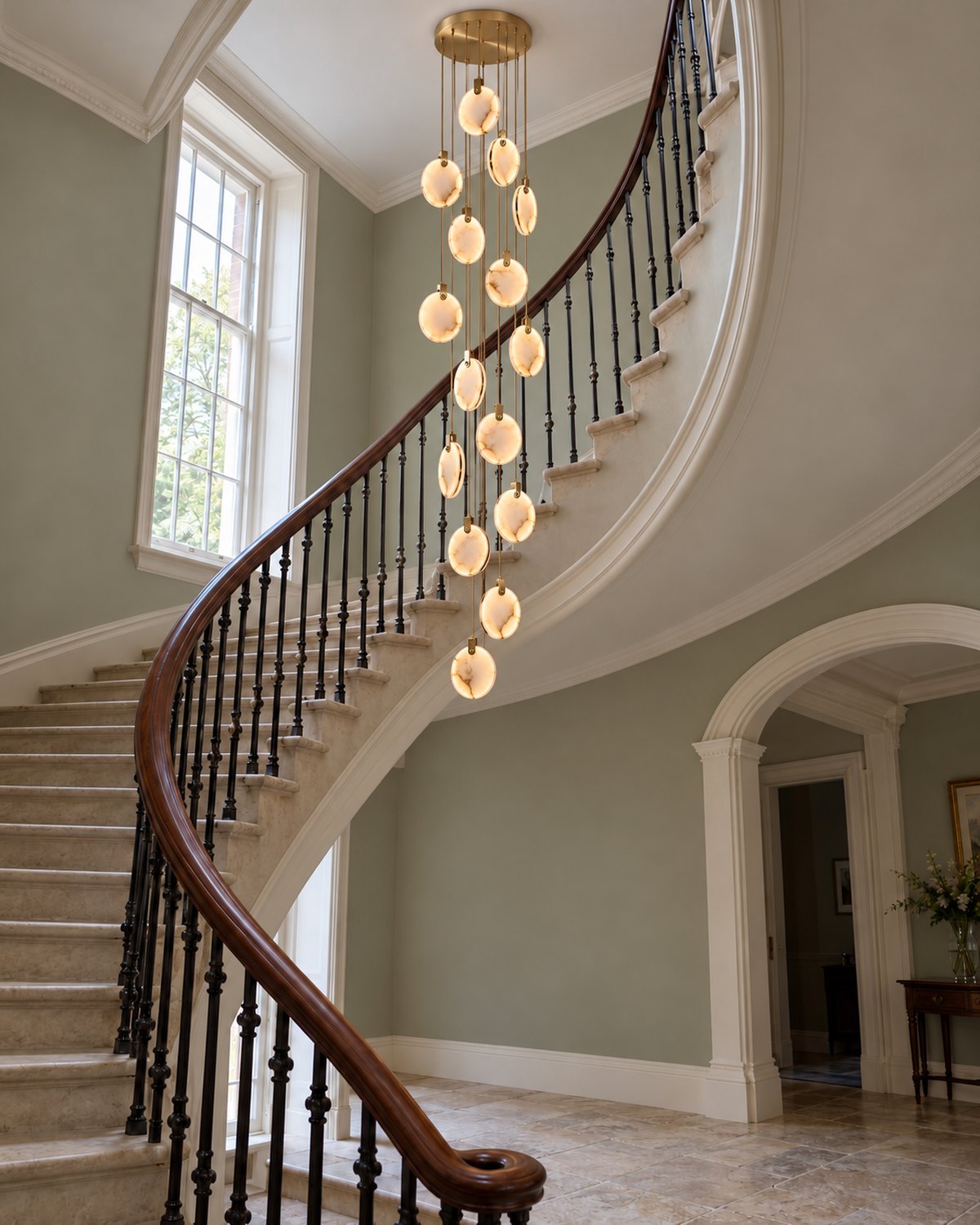
Castleton is a chandelier of natural alabaster discs spiralling round a gold frame, and its page suggests it over a large table or in the middle of a bedroom. You pick the number of discs: one alone is 20 cm across, while 27 make a chandelier 70 cm wide, and since each extra disc adds length as well as width, measure the ceiling height first. Only the remote-control version dims, which is worth knowing if you want a low light at dinner. If the ceiling is tall, our guide to lighting a high-ceilinged room covers drops.
Wall lights in pairs
A Georgian room is read from its centre lines: the fireplace, the windows, the doors. A single wall light off to one side breaks that. A matched pair, set at the same height and the same distance from the centre line, keeps it. Here is where pairs work best:
| Where | How to place the pair | What to measure |
|---|---|---|
| Chimney breast | One each side, the same distance from the centre of the fireplace | The wall space on each side of the breast |
| Overmantel mirror | Either side of the frame, so the glass doubles the light | The width of the frame, and the wall beyond it |
| Piers between sash windows | One centred on each pier | The width of each pier against the width of the light |
| A doorway or a pair of doors | One each side, level with each other | The architrave, so the backplates clear it |
Fix them between 1.5 and 1.8 m up, roughly at eye level, which keeps the bulb out of your line of sight from an armchair. Before anyone drills, mark both positions with masking tape and look from the doorway. Spacing is covered in detail in our guide to pairs of wall lights.
Two of ours suit a pair on a narrow pier. Bath pairs a broad disc of natural marble, which an LED hidden at the back lights up, with a ring in matt gold. It is 22 cm wide, and its page suggests the space between two doors or beside a staircase, so it should fit a narrow pier as well. Painswick is a round wall light in natural stone, 20 cm across, whose soft light comes from a frosted glass globe ringed by the stone. Its page suggests it for a dining room, a study or a library wall, and the ring comes in seven stones, from white jade to deep red marble. With natural stone, the two lights in your pair will each have their own veining, which is part of the appeal.
Low, warm light, and lamps
You won't recreate candlelight with an LED, nor do you need to, but staying around 2,700 K keeps a Georgian room from looking cold. Use the same colour temperature for every bulb in the room: a mix of warm and cool whites is the quickest way to make a fine room look patched together. Give the central light, the wall lights and the lamps separate switches, ideally dimmers, so the room can go from bright for a party to low for a quiet evening.
Lamps do a lot of work in these rooms. A pair on a console between the windows, or on matching side tables either side of a sofa, repeats the symmetry of the wall lights. And a lamp runs from a socket you already have, which counts for a lot in a listed house.
Lighting paintings and mirrors without new wiring
A portrait or a landscape over the fireplace deserves its own light. Where you would rather not run a new cable through old plaster, a battery picture light is one answer. Moreton is a slim battery bar made to fix above a painting or a mirror, in black or gold, with gold suiting a gilded frame. It recharges over USB and runs for up to 4 hours, which covers an evening. It goes up with screws or adhesive, so if the house is listed, ask about the fixing too. Placement and glare are covered in our guide to picture lights.
Measure first: a worked example
Say your drawing room is 4.5 × 4 m with a chimney breast on the long wall and two sash windows opposite. Length plus width is 8.5 m, times 8.3, gives a central light of about 70 cm across, the size of Castleton's largest version. Anywhere people walk beneath it, the light should hang no lower than 2.1 m (6 ft 11 in) from the floor. Then plan two wall lights flanking the breast at around 1.6 m, and a pair of lamps on the window wall. That makes five points of light: one on the ceiling, and four arranged in pairs on either side of the centre lines.
Is your Georgian home listed?
There is a fair chance. Under the government's listing principles, most buildings from 1700 to 1850 that still have much of their original fabric are likely to be judged of special interest. And listing protects the whole building, not just its front, so plasterwork, cornices and ceiling roses can be covered.
In England, the 1990 Listed Buildings Act requires listed building consent for works that would affect a listed building's character; Wales, Scotland and Northern Ireland have their own equivalent laws. Cutting a chase for a new wall light, replacing a ceiling or fixing into old beams can all count. Your council's conservation officer can tell you what needs consent, and it is worth asking before any work begins. A lamp, or a new light hung from an existing point without disturbing the plaster, is the least intrusive choice. For fixings in an old ceiling, see lath-and-plaster ceilings, ceiling roses and heavier lights.
Browse our living room lights with your measurements to hand. And before buying anything, sketch the room's centre lines on paper and mark where each light will sit: if the sketch looks balanced, so will the room. The page on older British homes in our free lighting guide collects the key numbers.

