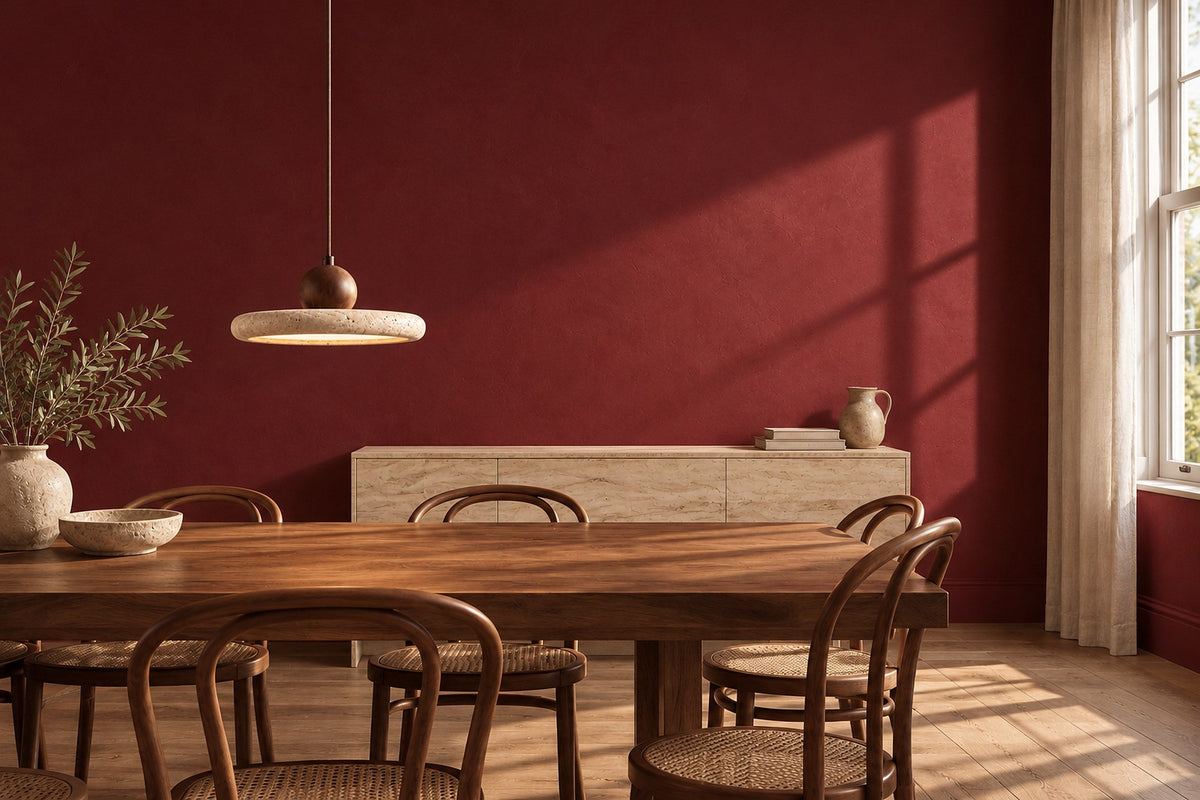
Cottage Lighting: Low Beams, Thick Walls, Small Windows
The cottage lighting ideas that work best go along with the building rather than fighting it. Keep anything that hangs to places nobody walks under, fix compact ceiling lights between the beams, and let wall lights and lamps do most of the work. Over any route people walk, the bottom of a light should clear the floor by 2.1 m, which is about 6 ft 11 in. A warm white of about 2,700 K and a few natural materials do the rest.
Old cottages bring their own puzzles: beams at head height, walls too thick and uneven for a neat fixing, and small windows that let in little daylight. Here is how to handle each one.
Headroom first: what fits under a low ceiling
Measure from the floor to the underside of each beam, at its lowest point, and to the plaster between them. Old beams are rarely level, so take a reading at each end. The figure that matters is that 2.1 m: anywhere people walk, the bottom of a light should stay above it. So a light's own height, added to 2.1 m, tells you the lowest ceiling it can go on over a walkway.
| Ceiling light | Height on its product page | Lowest ceiling over a walkway |
|---|---|---|
| Whitby, a flat tinted-glass ceiling light | 6 cm | 2.16 m (about 7 ft 1 in) |
| Helmsley, travertine and walnut | 10 cm | 2.20 m (about 7 ft 3 in) |
| Pickering, a black marble cylinder | 13 cm overall | 2.23 m (about 7 ft 4 in) |
| Burnham, glass and wood, stem included | 21 cm | 2.31 m (about 7 ft 7 in) |
Where a beam comes lower than the figure in the last column, put the light between the beams instead, or leave that part of the room to lamps. Helmsley brings a touch of stone and wood to the ceiling: a round of solid travertine 12 cm across, edged in walnut, in cream or black. At about 1.1 kg it is light, and its page says your existing light point will hold it with no reinforcement of the ceiling. Pickering is a short cylinder of black marble the same width, and its page puts it on the low ceilings of older houses, in a row along a landing or a corridor. For more on choosing between the two kinds of fitting, see flush or semi-flush, and for everything under 2.4 m, lighting for low ceilings.
Between the beams, and over the table
A compact light fixed to the plaster between two beams lights the room without anyone ducking. Measure the gap between the beams too, so the light sits centred with a little space either side. Fix it into timber, not into the plaster alone. A cottage ceiling may well be laths with plaster pushed through them, and our guide to lath-and-plaster ceilings and roses explains where the screws should go.
Over a dining table, nobody walks beneath the light, so it can hang lower: leave 60 to 90 cm from the table top up to the bottom of the shade, whatever the ceiling height. That is where a pendant earns its place in a low room.
Harrow is turned on the lathe from a single block of solid wood into a dome with ribs over its whole surface, and you can have it in 43 or 55 cm, in pale wood or walnut. It aims its light downwards onto whatever sits beneath it, which suits a table or a worktop. One point to check: its drop is fixed and cannot be adjusted, and its page doesn't give the length. Under a low ceiling, ask us for the figure before you order and work out where the bottom of the shade will sit.
The bedroom under the eaves
If a cottage bedroom leaves little room for a bedside table, a pendant hung low beside the bed can do a bedside lamp's job and free the surface. Looe's page suggests exactly that use: it is a small pendant with a high-gloss ceramic shade just 14 cm across, in white, red or green. Its flex adjusts up to 200 cm, so you can set the shade at the height that suits you, and with a dimmable bulb it can run from a dimmer switch. Keep it to the side of the bed, out of the path you walk, and set the height for reading.
Where there is height to spare, at the centre of a bedroom or study, Hawkshead brings a natural material overhead. Woven by hand in natural rattan, it is 50 cm wide, rising to a dome in the middle with a flat rim around it, and its light comes through the weave warm and diffused. Because each one is woven by hand, no two have quite the same weave.
Thick walls, deep sills and small windows
Small windows set in thick walls leave a deep sill, and a deep sill is a ready-made place for a lamp. A lamp there lights the window wall after dark, and on a winter afternoon it adds to what little daylight the window lets in.
A cordless lamp avoids running a flex across an old floor to the nearest socket, which in a cottage may be some way off. Alnwick is a wooden cordless lamp, 37.5 cm tall in beech or sapele, with a 10 cm head. One touch of a finger turns it on and sets its brightness, and its battery charges from a USB-C cable that comes with it. Our guide to cordless table lamps covers charging.
Uneven walls and old plaster
Wall lights in a cottage go on walls that are rarely flat. A few habits help:
- Choose a small backplate. A compact round plate sits flatter on undulating plaster than a wide one, which can rock or leave a gap.
- Find what is behind the plaster. Old walls may be stone, brick, cob or timber frame, with plaster laid straight onto the masonry. Brick and stone need a masonry drill bit and a plug; a timber stud takes a wood screw directly.
- Run a detector over the wall first. Cables buried in a wall tend to run vertically or horizontally from switches, sockets and light points, so never drill directly above, below or beside one.
- Keep the height. Wall lights normally sit 1.5 to 1.8 m above the floor. In a low room, keep to the lower end, and check that nobody's head passes close to a light that projects from the wall.
Warm, natural, and not cluttered
Cottages suit wood, rattan, ceramic and stone, and they suit warm light, around 2,700 K, one colour temperature per room. The risk in a small room is too many lights. Three or four sources usually do it in a sitting room: one compact light on the ceiling, a pair of wall lights or a wall light and a lamp, and a lamp in the window. Put them on separate switches where you can, so the ceiling light can stay off on a quiet evening. Browse our wooden lights and our ceiling lights with your measurements in hand.
Listed cottages
There is a good chance an old cottage is listed. Under the government's principles of selection, any building from before 1700 that still has much of its original fabric is likely to qualify, along with most from 1700 to 1850. And the protection can run through the whole house, interior included. England requires consent for works that alter the character of a listed building, and Wales, Scotland and Northern Ireland have their own laws to the same effect. Drilling into old beams, chasing a wall for a new cable or replacing a historic ceiling may all be caught, so talk to the conservation officer at your council before you start. Lamps leave the fabric alone entirely, and a new light on an existing point disturbs very little.
A quick checklist
- Height to the underside of every beam, and to the plaster between them
- Width of the gaps between beams
- Depth of each window sill, and the distance to the nearest socket
- What the walls are made of, and where any cables run
- Listed status, before any drilling into historic fabric
An electrician can do any of the fitting for you if you prefer. For the numbers behind every room, including a page on older British homes, download The Room-by-Room Lighting Guide, free.