


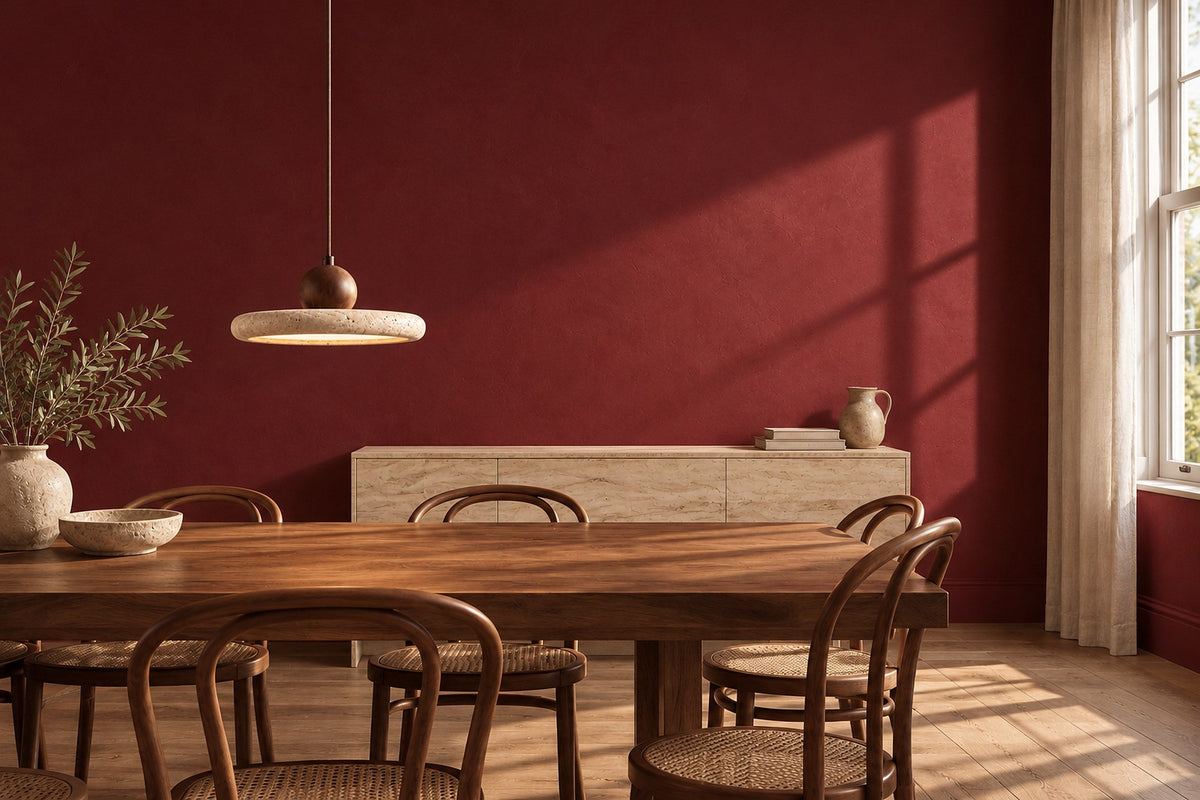
Modern Lights in a Period Home: Mixing Old and New
Modern lighting for Victorian homes works best when it is plainly modern and well proportioned: a simple shape in an honest material, sized to the room, hung from the original ceiling rose, with one statement piece per room. A good contemporary light often sits more comfortably under a cornice than a reproduction trying to pass for old. The same goes for Georgian, Edwardian and 1930s houses.
Contrast or copy?
The argument goes back to 1877. That year, William Morris, Philip Webb and the other founders of SPAB, the Society for the Protection of Ancient Buildings, wrote a manifesto that still guides it. It observes that changes made to old buildings in earlier centuries were made in the unmistakable fashion of their own time, and it calls restoration that imagines what earlier builders might have done "a feeble and lifeless forgery". Historic England's advice on making changes to heritage assets adds a practical principle: where possible, new work should be reversible.
For lighting, there is a further reason not to copy. Most Victorian houses were built for gas, oil lamps and candles, and as late as 1919 only 6% of British homes were wired for electricity, by the Science Museum Group's figures. So in many period rooms there was never an original electric light to reproduce. A modern fitting doesn't pretend otherwise. Our guide to lighting a Victorian house covers that history room by room.
None of this rules out a traditional light. It simply means a modern one is a respectable choice, not a compromise.
Materials that bridge old and new
The modern lights that look most at home in old rooms tend to use materials the house already knows: stone, wood, paper, glass. A plain shape in a natural material reads as calm rather than out of place.
| Material | Why it works in an old room | In our range |
|---|---|---|
| Stone | Picks up a marble fireplace or a stone hearth, if you have one | Tetbury, a disc of genuine travertine flat to the ceiling |
| Wood | Answers old floorboards and furniture | Masham, a wooden bar whose grain shows through the finish |
| Paper | Light in weight and in look, so the plasterwork stays the star | Southwold, a very slim paper disc |
| Painted metal | A clean block of colour against white cornicing | Ambleside, a metal disc in eight colours |
Southwold hangs flat, and when it is switched on its whole surface glows evenly, much like tracing paper held against a window. The paper is a tough technical grade that won't tear, kept taut and flat by a frame inside. It comes in five diameters from 40 to 100 cm, and you choose warm, neutral or cool white when you order. For a sitting room, choose the warmest option, 3,000 K.
Ambleside is a hanging metal disc, either 25 cm or 40 cm across, that directs a warm white light downwards through an acrylic panel on its underside. There are eight colours to choose from, quiet neutrals as well as brighter shades such as orange and pink. Its page puts the larger disc in the middle of a living room and keeps the smaller one for a hall.
Masham is a wooden bar with a warm white LED running its full length and shining downwards through an opal acrylic panel. There are four lengths, from 80 to 150 cm, and two wood tones, light and dark, and it hangs from a pair of cables you can set anywhere up to 150 cm. Over a long table, its light runs the length of it.
Getting the scale right against cornicing
Period rooms are generous, and a light that is too small looks timid next to deep cornicing. A handy starting point: measure the room in feet, add length to width, and treat the total as a diameter in inches (working in metres, multiply the total by 8.3 to get centimetres). A drawing room of 5 × 4.2 m, about 16 ft 5 in by 13 ft 9 in, comes out at roughly 76 cm (30 in). Then go up or down by around a tenth, as your eye prefers. For more on sizing, see what size ceiling light your room needs.
Before you buy, try the size out. Southwold's own page suggests a simple test: cut a paper circle the size you are considering and hold it up under the ceiling. Do it at dusk with the lights on, and look from the doorway.
Then check the drop. Over a dining table, the gap from the tabletop to the bottom of the light should be 60 to 90 cm. In a room 3.1 m high with a 75 cm table, aiming for 75 to 90 cm above it puts the bottom of the light 1.45 to 1.6 m below the ceiling. Southwold's cord and Ambleside's suspension each adjust up to 150 cm; add the depth of the light and compare the total with your drop before you order. Away from the table, wherever people pass under a pendant, make sure its lowest point stays 2.1 m (about 6 ft 11 in) off the floor, if not higher. Our guide to lighting a high-ceilinged room goes further.
Keep the rose, and keep it reversible
Whatever you hang from it, leave an original plaster rose where it is. The new light's fixing goes past the moulding into the joist or batten behind, and the plaster itself takes no load. A slim disc on a long cord leaves the rose and the cornice in full view, which is part of the point.
Check the weight too. The wiring regulations, BS 7671, have long set 5 kg as the least a pendant's fixing should carry, and expect the ceiling to suit the light's weight. Ambleside, for instance, is 2 kg at its smaller size and 2.8 kg at the larger. If the ceiling is the old lath-and-plaster kind, our page on those ceilings and their roses shows how to find the timber.
Reversible, in practice, means using the existing light point, leaving the plaster untouched, and keeping the old fitting if it has any value. The next owner can always change their mind. If the house is listed, works that affect its character need listed building consent, so check with your local conservation officer first, especially if the existing fitting is itself historic.
If you have a loft conversion, Southwold and Ambleside can both hang from a ceiling that slopes by up to 30°.
One statement per room
One modern piece makes a point. Three compete with each other and with the cornice. Choose the light that will be the room's statement, usually the one in the middle of the ceiling, and keep everything else quiet: two matching wall lights on the chimney breast wall, a lamp or two, all in the same warm white. Mixing a 2,700 K lamp with a cool-white ceiling light is a classic mistake, whatever the style of the fittings.
Tetbury is a quieter way in: genuine travertine in a flat disc, 38, 48 or 58 cm across, set straight against the ceiling with no wires on view and lit by a sealed 3000 K warm white LED. A flush disc would hide a moulded rose, so keep it for rooms where the ceiling is plain, such as a bedroom or a study.
Quick questions
Can a modern pendant hang next to period wall lights?
Yes. The link is the colour of the light, not the style of the fittings. Keep one colour temperature in the room, and the pieces read as a set.
Which white suits a period sitting room?
For the rooms you relax in, the sitting room, bedrooms and the dining room, about 2,700 K; for kitchens and studies, where you work, about 3,000 K. If a light only comes in set colours, pick its warmest white.
Browse our centrepiece lights for the one statement piece, then plan the quieter layers around it with our free Room-by-Room Lighting Guide; one of its pages deals with older British homes.

